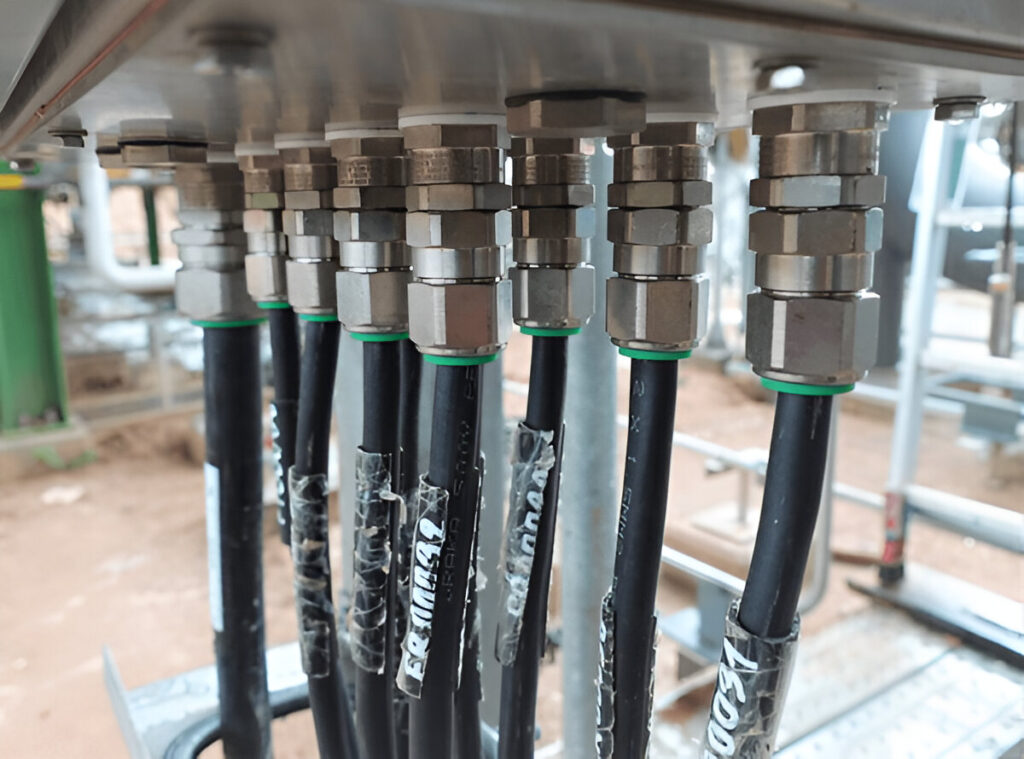
Cable glands are essential components in the machinery industry, ensuring secure and reliable cable connections. However, selecting the right cable gland with the appropriate dimensions can be a daunting task.
This guide will walk you through the key factors to consider when choosing cable glands, including thread size, clamping range, and overall dimensions. By the end, you’ll have a clear understanding of how to use cable gland size charts to make informed decisions for your specific application.
Thread Size
The thread size of a cable gland refers to the size and type of the threaded entry that allows the gland to be securely fastened to an enclosure or equipment. There are three main thread size standards commonly used for cable glands:
Metric Threads
Metric threads, designated by the letter M followed by the nominal diameter in millimeters, are the most widely used thread type for cable glands. Common metric thread sizes for cable glands include M12, M16, M20, M25, M32, M40, M50, and M63. These threads conform to the ISO 261 and ISO 965 standards, ensuring compatibility and interchangeability across different manufacturers.
NPT Threads
NPT (National Pipe Tapered) threads are commonly used in North America and some other regions. NPT threads have a tapered profile, with the diameter reducing from the start of the thread to the end. This taper allows for a tight, water-resistant seal when properly tightened. Common NPT thread sizes for cable glands include 1/4″, 3/8″, 1/2″, 3/4″, 1″, 1-1/4″, and 1-1/2″. NPT threads are defined by the ANSI/ASME B1.20.1 standard.
PG Threads
PG (Panzergewinde) threads, also known as PGXX or PG7 to PG48, are an older German standard that was widely used in Europe before the adoption of metric threads. While PG threads are less common in new installations, they are still encountered in older equipment and some specific applications. PG thread sizes are designated by a number that roughly corresponds to the hole diameter in millimeters.
Clamping Range
The clamping range of a cable gland specifies the minimum and maximum diameter of the cable that can be securely accommodated by the gland’s sealing and strain relief mechanisms. Cable glands often have interchangeable sealing inserts or multi-range seals that allow a single gland size to accommodate a range of cable diameters.
A gland with a clamping range that is too small will not allow the cable to be inserted, while a range that is too large will not provide adequate sealing or strain relief.
Manufacturers provide clamping range information in their product datasheets, typically specifying the minimum and maximum cable outer diameters for each gland size and sealing insert configuration.
Overall Dimensions
Length: The overall length of the cable gland, from the top of the entry thread to the bottom of the gland body.
Hex size: The size of the hexagonal nut or gland body, typically specified as the flat-to-flat distance in millimeters.
Outer diameter: The maximum outer diameter of the cable gland body.
Inner diameter: The minimum inner diameter of the cable entry opening.
Cable Gland Dimension Tables
Cores
1
2
3
4
5
6
7
10
12
19
Cable Size
1.5 mm
–
20S
20S
20S
20S
20S
20S
20
20
25
2.5 mm
–
20S
20S
20S
20S
20
20
25
25
25
4 mm
–
20S
20S
20
20
20
25
25
32
32
6 mm
–
20
20
20
20
25
25
32
32
–
10 mm
–
20
25
25
25
25
25
32
32
–
16 mm
–
25
25
25
25
32
32
–
–
–
25 mm
–
25
25
32
32
40
40
–
–
–
35 mm
–
25
32
32
40
–
–
–
–
–
50 mm
20
32
32
32
–
–
–
–
–
–
70 mm
25
32
32
40
–
–
–
–
–
–
How to Use a Cable Gland Size Chart
Cable gland size charts provide the information needed to match the gland to your specific cable. Here’s how to use a cable gland size chart effectively:
1. Identify the Cable Size
The first step is to accurately measure the outer diameter of your cable. Cable sizes are typically expressed in millimeters. Use a caliper or micrometer to take a precise measurement of the cable at the point where the gland will be installed. Check the cable’s datasheet if available to confirm the outer diameter.
2. Determine the Number of Cores
Next, count the number of cores (individual conductors) within the cable. Cable glands are available to accommodate different core quantities. The gland must have enough room to fit all the cores without compression. Common core counts are 2, 3, 4, and 5, but cables can have up to several dozen cores for specialized applications.
3. Find the Intersection
With cable diameter and core count known, consult the cable gland size chart. Charts are typically laid out in a matrix, with cable diameters on one axis and number of cores on the other. Find the cell where your cable’s diameter and core count intersect. This cell specifies which gland size is appropriate for your cable. Gland sizes may be expressed as a nominal thread size (such as M20 or 3/4″ NPT), or as a clamping range.
If your exact cable diameter is between two sizes, choose the gland with the clamping range that is closest to your measurement while still being large enough to accommodate the cable. Avoid sizing the gland too large, as this can compromise the seal.
Cable Gland Selection
Choosing the right cable gland involves more than just matching the size to the cable. Several other factors must be considered to ensure the gland will perform properly in its intended environment. Key selection criteria include:
Cable type and size: In addition to diameter, the cable’s shape, material, shielding, and other characteristics can influence gland selection. Verify gland compatibility with the specific cable type.
Operating temperature and pressure: Cable glands are rated for different temperature and pressure ranges. Ensure the selected gland is suited for the ambient conditions and any temperature extremes produced by the process. High pressure applications may require specialized glands.
Environmental conditions: Consider any environmental factors the gland will be exposed to, such as UV radiation, salt water, chemicals, or washdown. Choose glands with the appropriate material and plating to withstand these conditions over the expected service life.
Ingress protection (IP) rating: IP codes specify the level of protection against solid objects and liquids. The higher the IP rating, the greater the protection. Select a gland with an IP rating suitable for the installation location and expected exposure level.
Hazardous area classification: For installations in explosive atmospheres, select a cable gland certified for the specific gas/dust group and temperature class. Hazardous area glands must be installed according to the manufacturer’s instructions to maintain safety and compliance.
Approvals and Certifications: Depending on the industry and application, cable glands may require certain approvals or certifications, such as UL, CSA, ATEX, or IECEx. Verify that the selected gland carries the necessary certifications for your jurisdiction and intended use.
Cord Grips Cord grips, also known as gland cable fittings or cable glands, are mechanical devices designed to attach and secure the end of an electrical cable to equipment. These robust components provide a secure entry point for cables entering enclosures, panels, or junction boxes while offering comprehensive protection against environmental factors and mechanical stress. […]
What is a Cord Grip A cord grip is a mechanical device designed to secure, strain-relieve, and seal cables or wires as they enter electrical enclosures, equipment, or junction boxes. These essential components provide protection at cable entry points while maintaining the integrity of electrical connections. Often referred to as cable glands in some regions, […]
What is Cable Gland Thread A Cable Gland Thread is the engineered spiral ridge system machined onto cable glands that creates the critical connection point between cables and electrical enclosures. According to the International Cable Protection Committee, improper thread selection accounts for 32% of all cable entry failures in industrial settings. These precision-engineered threads serve […]